
Actually, traffic filtering as a bouncer for your landing page. It checks every visitor before they enter. Real people get in. Bots and fake users get turned away. Traffic filtering reads signals like IP reputation, device fingerprints, and click patterns in real time.
Without Facebook traffic filtering, you end up paying for clicks that don’t convert. You also train Meta’s algorithm to go after similar traffic, which quickly increases your costs.
Try the Google & Facebook Ads Traffic Filtering Tool Today
Invalid traffic shows up in normal-looking reports. It pumps up click counts and gives the false impression that a campaign is active and working. Therefore, to identify invalid traffic, traffic filtering must be continuously turned on and work in conjunction with your Facebook and Google Ads campaigns.
How Understanding Facebook Ads Traffic Quality
Quality traffic converts into low-quality traffic, wastes budget, and affects Meta’s optimization signals.
What Is High-Quality and Low-Quality Facebook Traffic?
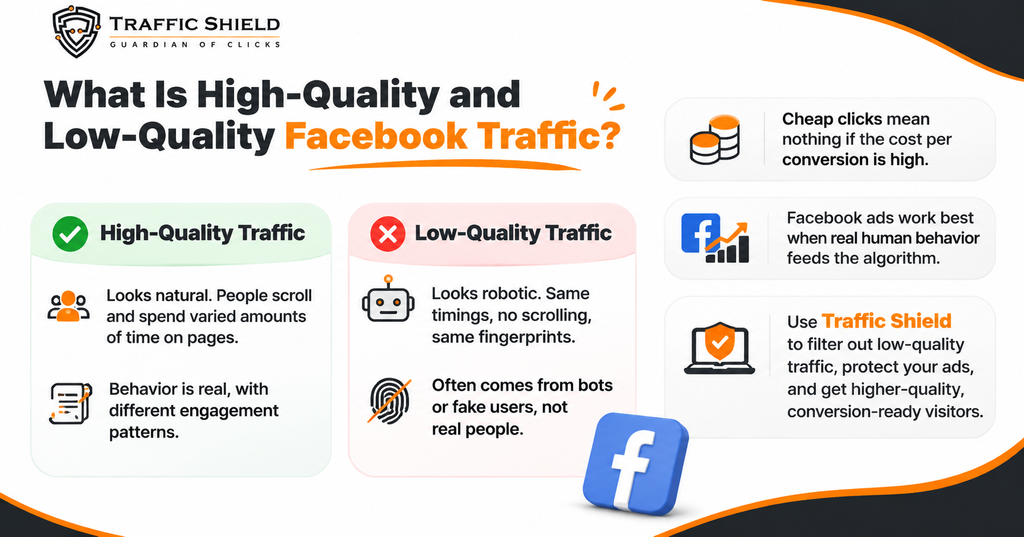
High-quality traffic comes from people who are interested and therefore potentially ready to buy. They take their time and compare before buying. Low quality traffic is from sources like bots and automation. It creates clicks, but not conversions.
Key points:
- Quality traffic looks natural. People scroll and spend varied amounts of time on pages.
- Low-quality traffic looks robotic. Same timings, no scrolling, same fingerprints.
- Cheap clicks mean nothing if the cost per conversion is high.
- The Facebook ads work best when real human behavior feeds the algorithm.
How to Identify Genuine Facebook Ad Visitors
Genuine visitors act like people with real interests. They spend different amounts of time on pages. They move between products and sometimes return. Their devices and locations match your targeting. They fill forms with realistic details.
Suspicious visitors click fast, leave instantly, and repeat the same pattern.
Main points:
- Real visitors scroll and click around.
- Actual humans spend varying time on your site.
- Form fills look legit with real names and intent.
- Same device clicking repeatedly deserves a closer look.
Common Signs of Suspicious Advertising Traffic
Sudden click spikes without matching landing page views are a classic warning. High bounce rates and geographic mismatches are red flags too. Traffic filtering catches these early.
Warning signs:
- Clicks shoot up but nothing changed in your campaign.
- The landing page views stay low even when clicks rise.
- The bounce rates go up while engagement drops.
- Traffic comes from data centers or untargeted regions.
Common Types of Invalid Traffic in Facebook Ads
There are different flavors of invalid traffic. Some are completely automated. Some fake activity with real people. Actually an issue like this is hidden behind VPNs and proxies.
- Bot Traffic and Automated Clicks: Scripts simulate clicks, scrolling, and form fills.
- Fake Clicks and Click Farms: Paid humans click all day long but never buy.
- VPN and Proxy Traffic—Fraudsters will mask their origin to avoid targeting.
- Repeated Clicking from Suspicious IPs: A single source is repeatedly clicking to drain the budget.
- Competitor Click Fraud: Your competition is using your money to limit your reach.
How to Identify Fake Clicks in Facebook Ads
Fake clicks leave a trail, and compare click data with landing page data and engagement data. When numbers stop lining up, investigate.
- Unusual Spikes: Clicks jump but conversions don’t follow.
- High clicks, low landing page views: The page never really loads for them.
- High Bounce Rates: Visitors bounce off immediately. No scrolling. No clicking.
- Unusual Geographic Patterns: clicks are coming from data centers or untargeted locations.
- Suspicious Behavior: Same session times or headless browser signals scream automation.
How Invalid Traffic Impacts Facebook Advertising Performance
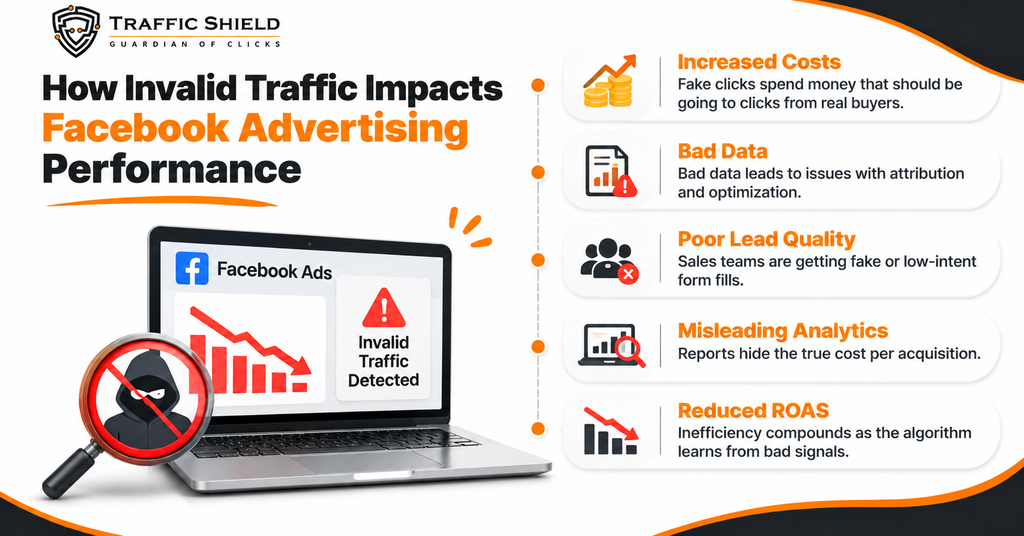
Invalid traffic: Here’s the thing about invalid traffic. It quietly messes with your data. And that impact snowballs over time. You think you’re optimizing for real buyers when you’re actually feeding the algorithm fake clicks.
Key effects:
- Increased Costs: Fake clicks spend money that should be going to clicks from real buyers.
- Bad Data: Bad data leads to issues with attribution and optimization.
- Poor Lead Quality. Sales teams are getting fake or low-intent form fills.
- Misleading Analytics: Reports hide the true cost per acquisition.
- Reduced ROAS: Inefficiency compounds as the algorithm learns from bad signals.
The Best Methods of Filter Invalid Facebook Ads Traffic
- Real-time clicks: Catch weird stuff as it happens.
- IP Reputation Analysis: Don’t let known bad actors pass your door.
- Device Fingerprinting: Detect bot activity.
- A.I. and Machine Learning: Learn patterns and adapt to new ones.
- AI-Powered Filtering: Learn from every click and adapt to new patterns.
Facebook Traffic Filtering Tools and Technologies
Think of these tools as a pit crew for your ad traffic. They check every click behind the scenes. They mix IP blacklists, fingerprinting, and machine learning to get it done. Hundreds of data points get scored in seconds. And they plug right into your Facebook ads, Google Ads campaigns, and retargeting audiences. Clean data in, clean data out. No mess.
Here’s what a good tool should give you:
- Real-time scoring. You know instantly if a click is trash.
- IP checks that flag sketchy networks early.
- Device fingerprinting that catches bots acting human.
- Intent-based analysis. Real behavior, not just clicks.
- Clear reporting. You see what got blocked and why.
How TrafficShield.io Helps Improve Advertising Traffic Quality
Let’s face it, you’re going to have a hard time keeping up and ensuring the quality of your ad traffic if you’re getting thousands of visits a day. TrafficShield.io was created for busy marketers and agencies who do not have the luxury of time to evaluate every click. This product employs an AI to scan your traffic and identify markers that signify sketchy visitors. At the end of the day, their goal is to remove the need for guesswork when assessing the quality of your traffic.
How TrafficShield.io supports traffic management:
- AI Analysis: Looks at a number of signals to identify potentially bad traffic
- IP Reputation Analysis: Flags sketchy IPs and network sources.
- The bot detection: Catches activity from automated systems.
- Browser and Device Analysis: Looks at technical visitor info.
- Filtering and Routing: Manages traffic using rules you set up.
- Campaign Insights: Gives visibility into visitor activity for smarter decisions.
So if you’re running Facebook ads or Google Ads campaigns, TrafficShield.io gives you that extra layer of monitoring. It helps you dig into suspicious visits and actually see what your traffic patterns look like. Getting more clicks isn’t the goal by itself. The goal is to get the right people on your site and make sure your traffic quality is actually good. Check out TrafficShield.io to learn more.
Frequently Asked Questions:
How do I stop fake clicks on Facebook Ads?
Monitor unusual click patterns and compare Facebook Ads reports with analytics. Use a traffic filtering tool to flag invalid visitors and apply the right rules.
Can Facebook detect invalid advertising traffic?
Yes. Meta uses automated systems to catch invalid activity. But also keep an eye on your own traffic and conversion data.
How can I identify bot traffic from Facebook campaigns?
Watch for unusual click frequency, short sessions, and odd behavior. Compare ad clicks with landing page views and real interactions.
What is the best Facebook traffic filtering tool?
It depends on your campaign needs and detection goals. TrafficShield.io is one option for AI-powered traffic analysis and filtering.


